Thursday, October 20, 2016

Bringing Pokémon GO to life on Google Cloud

Ref: https://cloudplatform.googleblog.com/2016/09/bringing-Pokemon-GO-to-life-on-Google-Cloud.html?m=1

Product updates, customer stories, and tips and tricks on Google Cloud Platform

Bringing Pokémon GO to life on Google Cloud

Thursday, September 29, 2016

Posted by Luke Stone, Director of Customer Reliability Engineering

Throughout my career as an engineer, I’ve had a hand in numerous product launches that grew to millions of users. User adoption typically happens gradually over several months, with new features and architectural changes scheduled over relatively long periods of time. Never have I taken part in anything close to the growth that Google Cloud customer Niantic experienced with the launch of Pokémon GO.

As a teaser, I’ll start with a picture worth a thousand words:

Our peers in the technical community have asked about the infrastructure that helped bring Pokémon GO to life for millions of players. Niantic and the Google Cloud teams put together this post to highlight some of the key components powering one of the most popular mobile games to date.

A shared fate

At our Horizon event today, we’ll be introducing Google Customer Reliability Engineering (CRE), a new engagement model in which technical staff from Google integrates with customer teams, creating a shared responsibility for the reliability and success of critical cloud applications. Google CRE’s first customer was Niantic, and its first assignment the launch of Pokémon GO — a true test if there ever was one!

Within 15 minutes of launching in Australia and New Zealand, player traffic surged well past Niantic’s expectations. This was the first indication to Niantic’s product and engineering teams that they had something truly special on their hands. Niantic phoned in to Google CRE for reinforcements, in anticipation of the US launch planned the next day. Niantic and Google Cloud — spanning CRE, SRE, development, product, support and executive teams — braced for a flood of new Pokémon Trainers, as Pokémon GO would go on to shatter all prior estimates of player traffic.

Creating the Pokémon game world

Pokémon GO is a mobile application that uses many services across Google Cloud, butCloud Datastore became a direct proxy for the game’s overall popularity given its role as the game’s primary database for capturing the Pokémon game world. The graph opening this blog post tells the story: the teams targeted 1X player traffic, with a worst-case estimate of roughly 5X this target. Pokémon GO’s popularity quickly surged player traffic to 50X the initial target, ten times the worst-case estimate. In response, Google CRE seamlessly provisioned extra capacity on behalf of Niantic to stay well ahead of their record-setting growth.

Not everything was smooth sailing at launch! When issues emerged around the game’s stability, Niantic and Google engineers braved each problem in sequence, working quickly to create and deploy solutions. Google CRE worked hand-in-hand with Niantic to review every part of their architecture, tapping the expertise of core Google Cloud engineers and product managers — all against a backdrop of millions of new players pouring into the game.

Pokémon powered by containers

Beyond being a global phenomenon, Pokémon GO is one of the most exciting examples of container-based development in the wild. The application logic for the game runs on Google Container Engine (GKE)powered by the open source Kubernetes project. Niantic chose GKE for its ability to orchestrate their container cluster at planetary-scale, freeing its team to focus on deploying live changes for their players. In this way, Niantic used Google Cloud to turn Pokémon GO into a service for millions of players, continuously adapting and improving.

One of the more daring technical feats accomplished by Niantic and the Google CRE team was to upgrade to a newer version of GKE that would allow for more than a thousand additional nodes to be added to its container cluster, in preparation for the highly anticipated launch in Japan. Akin to swapping out the plane’s engine in-flight, careful measures were taken to avoid disrupting existing players, cutting over to the new version while millions of new players signed up and joined the Pokémon game world. On top of this upgrade, Niantic and Google engineers worked in concert to replace theNetwork Load Balancer, deploying the newer and more sophisticated HTTP/S Load Balancer in its place. The HTTP/S Load Balancer is a global system tailored for HTTPS traffic, offering far more control, faster connections to users and higher throughput overall — a better fit for the amount and types of traffic Pokémon GO was seeing.

The lessons-learned from the US launch — generous capacity provisioning, the architectural swap to the latest version of Container Engine, along with the upgrade to the HTTP/S Load Balancer — paid off when the game launched without incident in Japan, where the number of new users signing up to play tripled the US launch two weeks earlier.
The Google Cloud GKE/Kubernetes team that supports many of our customers like NianticOther fun facts
The Pokémon GO game world was brought to life using over a dozen services across Google Cloud.Pokémon GO was the largestKubernetes deployment onGoogle Container Engine ever. Due to the scale of the cluster and accompanying throughput, a multitude of bugs were identified, fixed and merged into the open source project.To support Pokémon GO’s massive player base, Google provisioned many tens of thousands of cores for Niantic’s Container Engine cluster.Google’s global network helped reduce the overall latency for Pokémon Trainers inhabiting the game’s shared world. Game traffic travels Google’s private fiber network through most of its transit, delivering reliable, low-latency experiences for players worldwide. Even under the sea!Niantic’s Pokémon GO was an all-hands-on-deck launch that required quick and highly informed decisions across more than a half-dozen teams. The sheer scale and ambition of the game required Niantic to tap architectural and operational best-practices directly from the engineering teams who designed the underlying products. On behalf of the Google CRE team, I can say it was a rare pleasure to be part of such a memorable product launch that created joy for so many people around the world

Tuesday, October 18, 2016

What’s the Difference Between VHDL, Verilog, and SystemVerilog?

What’s the Difference Between VHDL, Verilog, and SystemVerilog?


Designing a complex SoC would be impossible without these three specialized hardware description languages.

Friday, October 14, 2016

ARM Cordio and Bluetooth Low Energy

https://community.arm.com/groups/embedded/blog/2016/09/08/could-removing-the-headphone-jack-mark-the-start-of-the-bluetooth-low-energy-audio-accessories-market?utm_source=SocialMedia&utm_medium=Organic&utm_campaign=Embedded

Tuesday, September 20, 2016

Word 2013 Equation: How To Add Bar above Text and Change the Default Font in Equation Editor From Cambria


How to add a bar over a letter

Use a built-in accent character
  1. Go to the Insert tab > Symbols group (far right), then click Equation.
  2. Select Insert New Equation from the bottom of the list.

    This opens the Equation Tools > Design tab and puts a Type equation here box into your document.
  3. Click Accent on the Design tab > Structures group.
  4. Scroll down past the Boxed Formulas section to the Overbars and Underbars section.
  5. Click the Overbar icon.

    You’ll see something like this in your document:
  6. Click in the dashed box, then type D.
  7. Click outside the equation box to hide it; you can show it again by clicking on the D with the macron.
Your character will look like this:

How To Change the Default Font in Equation Editor From Cambria


Out of the box, Office 2010 and 2013 have only Cambria with all of the math characters that are needed for the Equation Editor.  You can verify this is also how-to-change-the-font-in-equation-editoryour circumstance by clicking expand link at the bottom right of the TOOLS box in the EQUATION EDITOR > DESIGN tab


After some considerable effort, I have still not found a compatible font so I have posted this with Microsoft Partner Support and after some back and forth, this is what they said:

…Cambria Math is the only supported font that can be used in Equation Editor in Word 2013 for the time being. Anyway, the DEFAULT FONT is a drop down box and it will have alternates after some improvements are made by the developing team.

A slightly longer answer is the work around of forcing your equation to “NORMAL TEXT” (see the screen shot to the right).  The tells Word that you you are not writing math, just normal text which will then allow you to change the font at will.  The risk here is that you will lose characters because they don’t exist in your new font (say Arial).


Wednesday, July 13, 2016

Sunday, July 10, 2016

Concern Grows in U.S. Over China’s Drive to Make Chips

http://mobile.nytimes.com/2016/02/05/technology/concern-grows-in-us-over-chinas-drive-to-make-chips.html?ref=technology&WT.mc_id=SmartBriefs-Newsletter&WT.mc_ev=click&ad-keywords=smartbriefsnl&referer=http://www2.smartbrief.com/uyd/editProfile.action?t1=52353163&t2=http%3A%2F%2Fwww.nytimes.com%2F2016%2F02%2F05%2Ftechnology%2Fconcern-grows-in-us-over-chinas-drive-to-make-chips.html%3Fref%3Dtechnology

Concern Grows in U.S. Over China’s Drive to Make Chips

Advanced weapons like the Patriot Advanced Capability-3 missile interceptor unit use semiconductors made with a little-known but increasingly important material called gallium nitride. China is said to want the technology to make gallium nitride chips.

THE YOMIURI SHIMBUN, VIA ASSOCIATED PRESS IMAGES

By PAUL MOZUR and JANE PERLEZ

FEBRUARY 4, 2016

HONG KONG — China is spending billions of dollars on a major push to make its own microchips, an effort that could bolster its military capabilities as well as its homegrown technology industry.

Those ambitions are starting to be noticed in Washington.

Worries over China’s chip ambitions were the main reason that United States officials blocked the proposed purchase for as much as $2.9 billion of a controlling stake in a unit of the Dutch electronics companyPhilips by Chinese investors, according to one expert and a second person involved with the deal discussions.

The rare blockage underscores growing concern in Washington about Chinese efforts to acquire the know-how to make the semiconductors that work as the brains of all kinds of sophisticated electronics, including military applications like missile systems.

In the case of the Philips deal, the company said late last month that it wouldterminate a March 2015 agreement to sell a majority stake in its auto and light-emitting diode components business known as Lumileds to a group that included the Chinese investors GO Scale Capital and GSR Ventures. It cited concerns raised by the Committee on Foreign Investment in the United States, which reviews whether foreign investments in the country present a national security risk.

Philips said that despite efforts to alleviate concerns, the committee — known as Cfius — did not approve the transaction.

“There is a belief in the Cfius community that China has become innately hostile and that these aren’t just business deals anymore,” said James Lewis, a senior fellow at the Center for Strategic and International Studies, a research firm, who speaks to people connected with the committee’s process.

Philips did not respond to requests for comment. GSR Ventures, which sponsors GO Scale Capital, declined to comment.

James Ding Jian, managing director and chairman of GSR Ventures, whose bid for Lumileds was blocked by the United States for national security reasons.

IMAGINECHINA

Cfius, an interagency body that includes representatives from the Treasury and Justice Departments, declined to comment and does not make its findings public.

Cfius reviews have been a growing problem for outbound Chinese deals. According to the most recent data available, in 2012 and 2013 Chinese investment accounted for more committee reviews than money coming from any other country. A 2008 Chinese effort toinvest in the network equipment company 3Com was withdrawn while the committee was reviewing it.

Recently, the committee found acceptable a number of major Chinese deals, including a takeover of Smithfield Foods by Shuanghui International and Lenovo’s takeover of IBM’s low-end server unit. In 2012, President Obama ordered a Chinese company to stop building wind farms near an American military installation in Oregon after a negative Cfius review.

At the center of the committee’s concerns on the Philips deal, according to Mr. Lewis, was a little known but increasingly important advanced semiconductor material called gallium nitride. Though not a household name like silicon, gallium nitride, often referred to by its abbreviation GaN, could be used to construct a new generation of powerful and versatile microchips.

It has been used for decades in the low-energy light sources known as light-emitting diodes, and it features in technology as mundane as Blu-ray Disc players. But its resistance to heat and radiation give it a number of military and space applications. Gallium nitride chips are being used in radar for antiballistic missiles and in an Air Force radar system, called Space Fence, that is used to track space debris.

“Gallium nitride makes better-performing semiconductors that were key in upgrading Patriot radar systems,” said Mr. Lewis. “It’s classic dual use, sensitive in that it could be used in other advanced weapons sensors and jamming systems.”

Advancing its chip industry has been a major political initiative for Beijing. In recent years, analysts said, Chinese corporate espionage and hacking efforts have been aimed at stealing chip technology, while Chinese firms have usedgovernment funds to buy foreign companies and technology and attract engineers.

Wan Long, right, of the WH Group, and Larry Pope of the American pork company Smithfield Foods. WH Group acquired Smithfield in 2013. The Committee on Foreign Investment in the United States approved that deal.

BOBBY YIP / REUTERS

Last year, different subsidiaries of the state-controlled Tsinghua Holdings made a number of bids for American companies, including an unsuccessful $23 billion offer for the American memory chip maker Micron Technology and a $3.78 billion bidfor a 15 percent stake in the hard-drive maker Western Digital, which was accepted.

Last year’s spree of deal activity, and lack of American regulatory response, spurred a Sanford C. Bernstein analyst, Mark Newman, to say in a November report that the United States “runs the risk of being asleep at the wheel.” He cited efforts by South Korea and Taiwan to prevent China from acquiring some technology assets.

The Lumileds block is being interpreted by the chip industry as the United States “waking up a bit to the threat,” Mr. Newman said in an email.

Gallium nitride is particularly sensitive. One military industry magazine called the material the biggest thing since silicon, which is now commonly used to make the transistors in microchips. It citedRaytheon’s use of the material to make smaller, low-powered radar for American missile systems.

“Many say it’s the most important semiconductor material since silicon,” said Colin Humphreys, a British physicist at Cambridge University.

He said that while it was not clear what the United States government was worried about, research by LED companies into technology linking gallium nitride and silicon could have broader implications for creating advanced microchips that could be used in a wide array of electronics.

The would-be investor in Lumileds, GSR Ventures, also holds a stake in Lattice Power, a Chinese company that has been vocal about its efforts to develop technology related to gallium nitride and silicon.

In a November 2015 statement about a recent investigation into Chinese industrial espionage, Taiwan’s Ministry of Justice also expressed worries about China aiming at the material. Calling the mass production of gallium nitride a “key development project” for China, the ministry said it was concerned about the theft of trade secrets from Taiwanese companies working on the material and Chinese-led recruitment of engineers knowledgeable about it.

Correction: February 10, 2016

An article on Friday about China’s efforts to advance its microchip industry, including through the acquisition of stakes in foreign technology companies, misstated the status of a bid by a subsidiary of the state-controlled company Tsinghua Holdings for a 15 percent stake in Western Digital. While the offer was accepted, the deal awaits approval from the Committee on Foreign Investment in the United States. It is not yet a “successful purchase.”

Paul Mozur reported from Hong Kong, and Jane Perlez from Beijing.

Sunday, June 26, 2016

Top 9 Mobile Apps Source Code Marketplace

https://www.digifloor.com/top-9-mobile-apps-marketplace-buy-sell-source-code-21

DigiFloor

Gadgets» Apple» Google» Digital Marketing» Microsoft» Tips & Tricks» Games Events DigiFloor News Review

About Us Contact Us Write for DigiFloor Shop»

Top 9 Mobile Apps Marketplace to Buy and Sell Source Code

Are you mobile application developers and looking for a ways to make money out of it? This article is for you! No matter whether you are iPhone or Android application developer; mobile app marketplaces are the blessing for developer community. Lets see who!

Mobile application marketplaces are the best source for apps developers to make their development task easier. It offers exciting opportunities to make extra money by buying or selling mobile app source codes at reasonable prices. Mobile application development is considered one of the most competitive market and it is challenging job for developers to fulfill the requirements of client. When it comes to meeting client’s deadlines, buying app source code from marketplaces can help you by offering ready made working modules to complete your iphone or android projects on time.

As there are hundreds of mobile market places available online, it is difficult to choose the best one which offers trusted and reliable apps source code. To make your job easier, i did research by considering numbers of factors to prepare the list of top #9 mobile apps source code marketplaces which offers:

Huge collection of latest source codes for iOS, Android, Windows and other platformsThe original app source code as claimed by developersRefund if you are not happy with the projectWorking source codes developed by experienced app developersCustomization and enhancement support by original developerHaving positive feedback from existing buyersCompatible with latest iOS / Android or respective operating system

If you are newbie and want to learn mobile application development by exploring FREE source codes, don’t worry; few marketplaces listed here are also stocks huge collection of Free app source codes of working projects. Lets explore the all popular source code market places.

Popular Mobile Application Source Code Marketplaces

#1 SellMyApp

Sellmyapp is one of the oldest mobile application source code marketplaces having huge collection of source codes for Android & iOS in different niche. It provides excellent quality source codes and has a dedicated team of professionals that provide Reskin and coding services for the items purchased on the marketplace. With a buyer protection of 14 days for any purchase and a great support system this is by far one of the best choices for mobile source code shopping.

#2 CodeCanyon.net

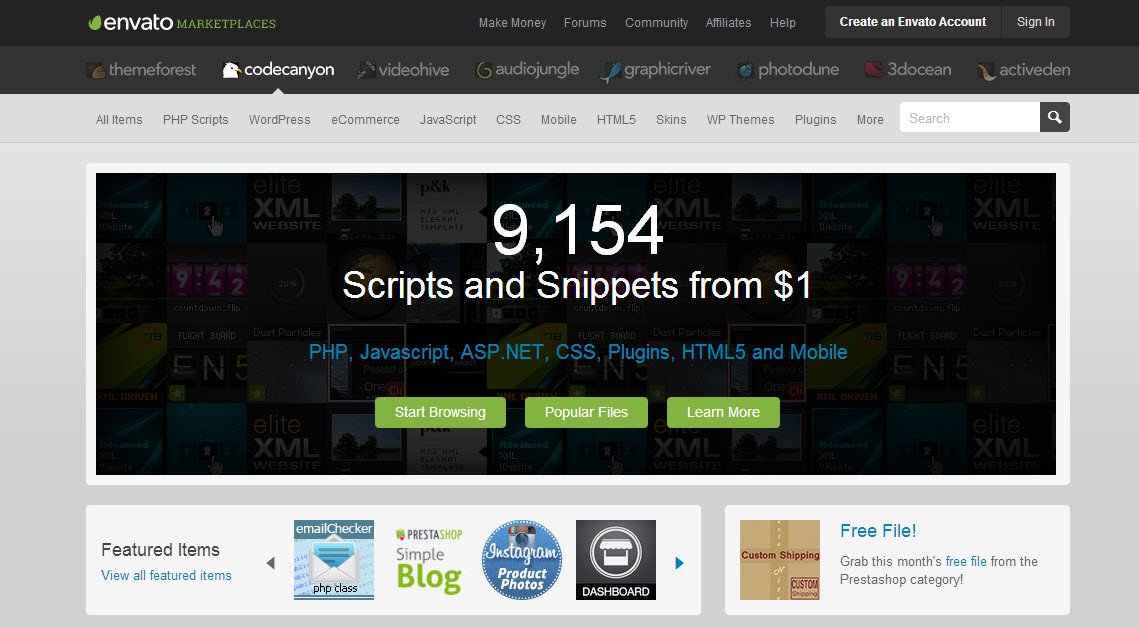
Codecanyon is a popular market place owned by world’s popular brand Envato. You can buy as well as sell your app source codes at Envato market place and can earn huge commission too. Here you will get various components for the variety of languages and frameworks like PHP, Java, JavaScript, ASP.NET and many others.

There is a large collection of high quality mobile app source codes for all different platforms. Not only do they sell iOS app source codes or Android source codes, they also have many app source codes for SDK’s to build hybrid apps. You can find source codes built in Unity, Corona and Titanium platform to deploy for all different app stores with small customization.

#3 Codester

Codester is not just selling mobile apps source code but also offers big platform for web application developers. It is one of the largest inventory for Scripts, Apps, plugins, themes, templates source codes. Codester is a marketplace where designers and developers can buy and sell PHP scripts, app source codes, themes, plugins and more. They have a separate section for mobile app source code categorized by iOS, Android, Unity, Corona and Tatanium source codes.

#4 GameGorillaz.com

GameGorillaz is one of the best games source code marketplaces we have come across in terms of the quality of codes listed. The USP of this website is that all the codes listed have a strong case to present in terms of the downloads they have received. Considering this, when you buy a code from GameGorillaz you are pretty sure that you are working with a tried/ tested and a successful project. The varieties of source codes range from small games for beginners to large sized game for advanced game developers are available on this platform. Even though in terms of numbers GameGorillaz is still growing, but even then it has made a solid name for itself in the code selling arena. You can buy latest games source code in Cocos 2D 3D, Unity 3D and in various latest 3D models for both iOS and Android platforms.

#5 ChupaMobile.com

Chupamobile is one of the leading marketplaces from where anyone can buy and sell professional Apps as well as games source codes at highly competitive price. This one-stop mobile apps source code marketplace offers you the largest library of ready to use apps that can help you to save upto 90% of the app development time and cost in order to launch your Android or iOS application. With this portal you can have your own app and can easily use them without any development skills. With over 3500+ app source codes & templates plus 15K+ user base, chupamobile is leading the mobile app source code industry. They also offers FREE learning tutorials for developers to sharpen their apps development skills.

#6 Flippa – An entrepreneur’s marketplace

Flippa is considered as world’s most popular website & domain market placeand now has strong presence in mobile application source codes too. Flippa is true entrepreneur’s market place where you can buy or sell android & iOS application businesses and can make big money out of it. Showcase over thousands of applications; you will have vast option to choose from. The process is pretty simple; just list your functioning application along with download or earning statistics and your selling price. Buyers will check this information and may ask query directly from there or can bid their offer which can be accepted or rejected by seller.

#7 SellMySourceCode.com

Sell My Source Code is world’s emerging marketplace from where you can buy and sell the source codes of Android, iOS,Windows platforms and best known for their 3D games source codes. This marketplace offers an exciting opportunity for the mobile application developers to get ready to use source codes. With this portal users can also download their required source codes at free of costs. With huge collection of source code, Sell My Source Code is also including more and unique application every day. As per recent updates, they are getting more popularity because of their unique application and support. If you are in need to customize existing source code or want to enhance the feature, they are having team of experience mobile apps developers who can make it possible at very competitive prices.

#8 ApkaCode.com

ApkaCode.com is an unique mobile app marketplace which allows iOS and Android developers to sell and buy their source code and generate extra revenue from it. It is an emerging platform for app developers and investors to buy, sell, or license existing mobile apps/games. Here investors can easily find mobile apps source code for different category like Games, Entertainment, Finance & other utilities at best price.

#9 Apptopia.com

Apptopia is a marketplace from where you will get most actionable mobile app data and insights into the industry so that you will be able to make your business decisions easily and quickly. They provide transparent app economy in order to make all the data available to many people.

Bonus:

AppsFresh.com

Appsfresh provides feature quality of iOS source codes for sale that are easy to reskin. These source codes are helpful in making money for your app flipping business. Their quality game source codes for the iOS platform are very popular. Appsfresh also offers app store optimization packages in order to improve your keywords and to get the high exposure to your app in the App Store.

SellMyApp.com

SellMyApp is the first choice for all the developers to sell or license their source codes. Their source codes are ready to use so you can quickly start your mobile development business. They promote your app with link-backs and provide Global App Marketing Exposure with free memberships. The mobile version of sellmyapp provides high flexibility.

AppResk.in

AppResk is one of the emerging online marketplaces since 2011 working on mobile apps development & wide range of customers. AppResk have small innovative mobile game developers team which brings your ideas to real visual games. AppResk team works on different platforms like Graphics design, Game UI & Unity 3D and delivers absolutely amazing results. Users can buy source code for different platform from this marketplace along with Graphics reskin at very reasonable price with full support.

I tried my best to list the top marketplaces as per my knowledge and understanding, if you have any recommendation for this list; do write here by comment or drop me an email. I will review the marketplace and will include in this list.

filed under: android, iphone, source code, tips & tricks tagged with: appsfresh, appshopper,appsplit, apptopia, binpress, chupamobile,codecanyon, mobile apps marketplace, mobile apps source code, mobile apps source code marketplace, sellmyapp, sellmyapplication,sellmysourcecode

About Jignesh Gohel

Jignesh gohel is a Google Adwords certified professional and digital marketing consultant having over 8 years of experience. He loves writing about gadgets, pay per click advertisement and online marketing.
Connect with him here at Linkedin - Jignesh Gohel

Stay Connected


Popular Posts

5 Best After Effects Templates for Logo and Text Animation

7 Quick Things to do When Your Smartphone is Lost or Stolen

Popular iPhone 6 Cases on Amazon Under $30

6 Easy Ways to Make Fast Money in GTA 5

7 Must have Browsers Extensions for Online Marketers

Subscribe Now

Best Buy

iPhone 6S and iPhone 6S Plus FeaturesSamsung Galaxy A5 Specifications & Features$499.00


DigiFloor

Terms of ServicesPrivacy PolicyContact Us

Product Categories

Select a categoryAcer  Apple  Dell  HP  HTC  Karbonn  Laptops  Micromax  Nokia  Smartphones  Xiaomi 

Social Presence

Copyright © 2016 DigiFloor